
What to Expect When Moving to Charlotte NC
Moving to Charlotte means choosing between Mecklenburg County and surrounding suburbs in NC and SC, navigating a 60-day DMV deadline for your driver’s license and vehicle registration, and starting your housing search well before your move date. A local agent who knows the full metro makes the process significantly smoother.
What do you need to know before relocating to Charlotte, NC?
Relocating to Charlotte means more than picking a zip code. You’re choosing between two states, multiple counties, distinct commute patterns, and a housing market that moves quickly in the most in-demand corridors. The good news: with the right sequence and the right local guidance, the process is very manageable.
Key Takeaways
- New North Carolina residents must obtain an N.C. driver’s license within 60 days of establishing permanent residence, according to N.C. Division of Motor Vehicles.
- Vehicle registration may be triggered earlier than 60 days if you accept employment in North Carolina, so don’t assume every DMV deadline is the same date.
- The Charlotte metro spans two states: communities like Indian Land and Fort Mill sit in York County, SC, and carry different tax structures, registration rules, and county services than Mecklenburg or Union County, NC.
- Starting your housing search 90 to 120 days before your target move date gives you enough runway to tour neighborhoods, get under contract, and close without rushing.
- Beginning October 1, 2026, NCDMV plans to move to electronic vehicle registration, eliminating physical plate stickers and printed registration cards for new registrations and renewals.
Should you live in Charlotte proper or in a surrounding suburb?
This is the first question I get from almost every relocation client, and the honest answer is: it depends entirely on where you’re working and what kind of daily life you want.
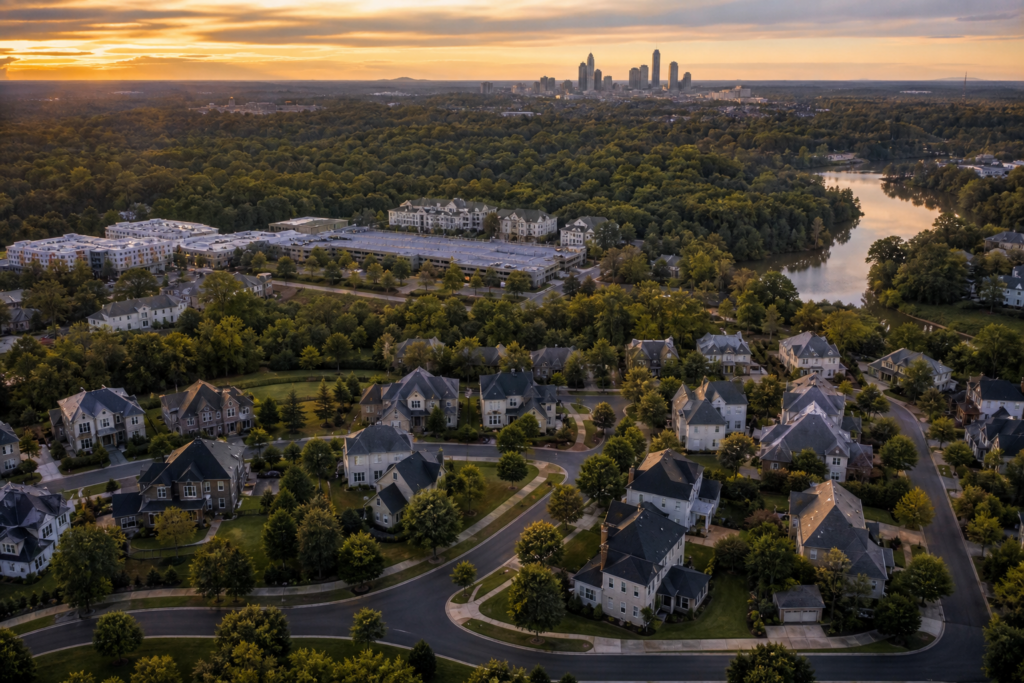
The Charlotte metro is large. Mecklenburg County holds the city of Charlotte itself, along with communities like Ballantyne, SouthPark, and Providence. Surrounding North Carolina counties include Union County (Weddington, Waxhaw, Indian Trail), Cabarrus County (Concord, Kannapolis), Gaston County (Belmont, Gastonia), and Iredell County (Mooresville, Davidson). Cross the state line and you’re in York County, South Carolina, home to Fort Mill and Indian Land.
Each of these areas has its own property tax rates, county services, school districts, and commute profile. They are genuinely different places, not just different zip codes. I work across this entire footprint, and I always tell relocation clients to resist picking a neighborhood off a list before they’ve thought through where they’ll be spending their time on a Tuesday morning.
What’s the difference between the NC side and the SC side?
The South Carolina side of the metro, particularly York County, has historically attracted buyers because of its tax structure. South Carolina has its own income tax rates, vehicle property tax rules, and homestead exemption program that differ from North Carolina’s. If you’re moving to Indian Land or Fort Mill, you’ll register your vehicle in South Carolina through SC DMV, not NCDMV, and the timelines and documentation requirements are different. Confirm your specific obligations with SC DMV directly.
On the North Carolina side, Mecklenburg County and its neighbors each set their own county tax rates on top of the state rate. Union County communities like Waxhaw and Weddington tend to offer more land and newer construction at price points that can differ meaningfully from comparable homes closer to uptown Charlotte. Your actual costs depend on the specific municipality and county, so verify current rates with the relevant county tax office before you commit.
What should you know about commuting in the Charlotte metro?
Charlotte’s road network is heavily hub-and-spoke. Interstate 485, the outer belt, connects most of the southern suburbs, but peak-hour congestion on I-77, I-85, and the surface roads feeding uptown can add real time to a commute. Charlotte Area Transit System (CATS) operates the LYNX Blue Line light rail, which runs from I-485 in the south through uptown and into NoDa. If your employer is near a station, the rail is genuinely useful. If you’re commuting to a suburban office park, you’re almost certainly driving.
I always suggest that relocation clients do a dry run of their commute during a weekday before they commit to a neighborhood. A home that looks perfectly positioned on a map can add 45 minutes each way in the wrong traffic corridor.
What’s the DMV process after moving to Charlotte from another state?
This is the administrative piece that catches the most people off guard. Here’s the sequence that NCDMV outlines for new North Carolina residents:
- Get your N.C. driver’s license first. You have 60 days from establishing permanent residence. NCDMV’s documentation list includes proof of identity, your out-of-state license, proof of your Social Security number, proof of your North Carolina address, and N.C. insurance information.
- Obtain a North Carolina title for your vehicle. NCDMV requires a North Carolina title before you can register a vehicle in the state.
- Register your vehicle. Out-of-state insurance is not accepted for N.C. registration. You’ll need N.C. insurance in place, along with the title or lender registration card, title-application forms, an odometer disclosure for vehicles under 10 years old, and your new N.C. license.
One important nuance on timing: the 60-day clock is the driver’s license deadline, but vehicle registration can be triggered earlier if you accept gainful employment in North Carolina or if an applicable reciprocity period runs out sooner. Don’t assume every deadline lands on the same day. Check your specific situation with NCDMV directly.
Also worth knowing: NCDMV has announced a transition to electronic vehicle registration scheduled for October 1, 2026. If your move happens on or after that date, the process for new registrations and renewals is expected to be fully digital, with no physical plate stickers or printed registration cards. Verify the agency’s current implementation status at the time of your move.
| Task | Deadline / Trigger | Where to Go |
|---|---|---|
| N.C. driver’s license | Within 60 days of establishing permanent residence | NCDMV driver’s license office |
| N.C. vehicle title | Required before registration | NCDMV or local license-plate agency |
| N.C. vehicle registration | 60 days, or earlier if employed in NC | NCDMV or local license-plate agency |
| N.C. insurance | Required before registration | Your insurance provider |
| Address update (existing NC residents moving within NC) | Within 60 days of move | NCDMV |
How early should you start your housing search before moving to Charlotte?
I’d put 90 to 120 days as the realistic window for most relocation buyers. That gives you time to research neighborhoods, schedule visits (ideally in person, but video tours work for a first pass), get pre-approved, make an offer, and close without compressing the timeline into a stressful sprint. If you’re targeting a specific price range in a competitive corridor like Ballantyne, Weddington, or Indian Land, inventory moves fast and you want options, not desperation.
The housing market across the Charlotte metro has remained active through 2026, with demand concentrated in the southern suburbs. Because a verified metro-wide median sale price for the most recent months wasn’t available at publication, I’d encourage you to book a call with me for a current picture of what inventory and pricing look like in the specific areas you’re considering. A number pulled from a national portal won’t tell you what’s actually happening in Waxhaw or SouthPark this week.
If you’re also figuring out how much cash you’ll need to close, I’d point you to my breakdown of how much cash it takes to buy a home in Charlotte, it covers the real costs beyond the down payment that catch a lot of relocation buyers off guard.
One thing I tell every relocation client: don’t skip the in-person visit to at least two or three neighborhoods before you go under contract. Photos and virtual tours can’t replicate what it feels like to sit in traffic on Providence Road at 5:30 p.m. or walk through a neighborhood on a Saturday morning. That context matters, and it’s the kind of thing I walk every client through before we start writing offers.
Before you start touring homes, make sure you have a pre-approval from a lender in hand. In a market where well-priced homes in desirable areas move quickly, sellers and their agents take pre-approved buyers far more seriously than those who are still in the “thinking about it” stage.
According to the National Association of Realtors, relocation buyers consistently rank neighborhood quality and commute time as top priorities, often above price. That tracks exactly with what I see working with clients moving to the Charlotte area from other states. The communities that feel right on paper don’t always feel right once you’re driving them.
The City of Charlotte’s official site and Mecklenburg County are both good starting points for understanding municipal services, tax rates, and county resources once you’ve narrowed your search to the NC side. For York County, SC, the York County government site has the equivalent information for communities like Fort Mill and Indian Land.
Before you read reviews of neighborhoods online, keep in mind that a lot of what gets shared publicly reflects one person’s experience at one point in time. The best way to understand what a community is actually like is to spend time in it, talk to people, and work with an agent who covers the full metro and can give you an honest, unfiltered picture.
Before you finalize anything, read through what NCDMV publishes for new residents directly. Requirements and timelines can shift, and the agency’s own pages are the authoritative source.
Ready to talk through your relocation? I’d love to help you map out the right neighborhoods, understand your real costs, and put together a timeline that makes sense for your situation. Book a call here or call or text me at 803-445-6998.
Want to read what past clients have said about working with me? Check out my reviews on Google, Zillow, and Realtor.com.
FAQ: Moving to Charlotte NC
What do I need to do after moving to Charlotte from another state?
Your first administrative priority is getting a North Carolina driver’s license within 60 days of establishing permanent residence, followed by titling and registering your vehicle with NCDMV. You’ll need N.C. insurance in place before you can register your car, and out-of-state policies are not accepted for registration. Beyond DMV tasks, you’ll want to update your address with the postal service, your bank, your employer, and any state agencies from your prior state.
How long do I have to get a North Carolina driver’s license after moving to Charlotte?
New North Carolina residents have 60 days from establishing permanent residence to obtain an N.C. driver’s license, according to NCDMV. You’ll need proof of identity, your out-of-state license, proof of your Social Security number, proof of your N.C. address, and N.C. insurance information. Get the license first, then handle vehicle titling and registration.
How do I register my car in North Carolina after moving to Charlotte?
NCDMV requires you to obtain a North Carolina title before you can register your vehicle, so the sequence matters. Once you have your N.C. driver’s license and N.C. insurance, you can complete the title and registration through NCDMV or a local license-plate agency. Note that vehicle registration can be triggered earlier than 60 days if you accept employment in North Carolina, so confirm your specific deadline with NCDMV rather than assuming you have the full 60 days.
Should I live in Charlotte proper or in a surrounding suburb?
The right answer depends on where you work, how much you want to commute, and what kind of property and community you’re looking for. Charlotte proper and Mecklenburg County offer proximity to uptown, established neighborhoods like SouthPark and Ballantyne, and access to the LYNX light rail. Surrounding suburbs like Weddington, Waxhaw, and Indian Land in York County, SC, tend to offer more land and newer construction, but require a car commute for most destinations. I work across the full metro and can walk you through the real trade-offs for your situation.
How early should I start looking for housing before moving to Charlotte?
Starting 90 to 120 days before your target move date gives you enough time to research neighborhoods, tour homes, get pre-approved, and close without unnecessary pressure. In competitive corridors like Ballantyne, Weddington, and Indian Land, well-priced homes move quickly, so having more runway gives you better options. If your timeline is shorter, it’s still workable, but you’ll want to move quickly once you identify the right home.
This article is general information only and is not legal, tax, or financial advice. Confirm your specific costs and obligations with your closing agent, tax advisor, or lender. Equal Housing Opportunity. Carin Miller, NC #287376 | SC #95417, Real Broker LLC.